
Yes. Health First Colorado includes preventive and diagnostic dental care, but related services can share a frequency limit. The exact service, age, recent claim history, and documented risk level all matter.
The standard adult and children's benefit is two routine cleanings. Some members with a dentist-documented higher risk may qualify for additional eligible cleaning or periodontal-maintenance visits after benefit review.
“A checkup” can include several different benefits
Health First Colorado has separate benefits for regular checkups, full dental exams, detailed gum exams, visits focused on a specific problem, routine cleanings, follow-up cleanings after gum treatment, and different kinds of X-rays. Your dentist recommends the service that fits your needs and prior care.
Coverage for one item does not confirm the others. A member can be eligible for a routine cleaning while a full-mouth X-ray is not yet available, or an examination can show that a routine cleaning is not the right service because active gum treatment is needed.
Standard adult frequencies and shared limits
For standard Health First Colorado members age 21 and over, the current benefit information supports these patient-facing planning points:
These standard frequencies help you and your dental team plan care. The exact procedure, service history, documented risk, treating dentist, location, and current eligibility determine what is available. Covered adult preventive and diagnostic services generally count toward the $3,000 July–June adult limit that began July 1, 2026.
- Periodic, comprehensive, and comprehensive periodontal exams can share a combined allowance of two during a 12-month period. A comprehensive oral exam also has a once-every-three-years limit per location, and a comprehensive periodontal exam has its own three-year timing rule.
- Problem-focused limited examinations use a separate frequency group and are generally listed as two per 12 months per location.
- A routine cleaning is generally available twice per 12 months. Routine cleanings, cleanings for widespread gum inflammation, and follow-up cleanings after gum treatment (periodontal maintenance) can count toward the same combined visit limit.
- Members with a documented higher risk may qualify for up to four total eligible cleaning or periodontal-maintenance visits in 12 months after review. This does not mean four of every cleaning type.
- Silver diamine fluoride is generally listed twice per 12 months per tooth.
- For adults, a full-mouth series, vertical bitewings, and a panoramic image generally use a shared five-year image group. A recent panoramic image can therefore affect availability of another full-mouth image category.
- The one-, two-, three-, and four-image bitewing options generally share one bitewing-set allowance per 12 months; they are not four separate annual benefits.
Children's cleaning, fluoride, sealant, and imaging schedule
The current children's benefit summary covers Health First Colorado members age 0 through 20. It lists two periodic exams and two routine cleanings per year. A documented higher risk can support review for up to four total eligible cleaning or periodontal-maintenance visits in a year; the dentist must document the risk and the additional visit is not automatic.
Federal Medicaid protections for members under 21, called EPSDT, require an individual review of medically necessary care that Medicaid can cover. If a child needs care more often than the standard schedule allows, the dentist can submit records explaining the need so the program can review the request.
- The child benefit summary lists two fluoride applications per year for ages 0–4 and three for ages 5–20. Children ages 0–4 with documented high cavity risk may qualify for up to four. The dental team should check the required risk assessment and prior service history.
- Sealants are listed for qualifying children ages 5–15, with tooth-specific lifetime limits.
- Space maintainers are listed for qualifying children ages 0–14.
- The children's summary lists full-mouth and vertical bitewing images once every five years per provider or location, while panoramic images are listed once every three years per provider or location.
- Different bitewing-set sizes share a frequency group. For some children with a documented higher decay risk, a shorter bitewing interval may be reviewed when clinically appropriate.
- Cover All Coloradans children have a separate $1,100 July–June dental limit beginning July 1, 2026; do not apply the standard child annual-limit statement to that program.
What a documented higher-risk exception means
The standard cleaning schedule is the starting point. A dentist may identify a higher risk of tooth decay or periodontal disease from the examination, health history, prior treatment, and current findings. When the program's criteria are met, the office can document that status so an additional eligible preventive or maintenance visit can be reviewed.
Your dentist assesses risk during an examination and may update that assessment at later visits. The office can explain how your assessment fits with age, frequency, annual-limit, and medical-necessity rules.
Why X-ray categories can share one frequency limit
Dental X-rays are diagnostic tools, not one universal benefit. A full-mouth series, panoramic image, vertical bitewings, a standard bitewing set, and an image of one tooth can use different timing rules. Some categories are considered equivalent for frequency purposes, so receiving one can affect when another becomes available.
Bring or transfer recent images when changing dentists. The new dentist decides whether they are current and diagnostically usable. If a new image is clinically necessary before the ordinary interval, ask whether a documented exception or EPSDT review is available rather than assuming it will be covered automatically.
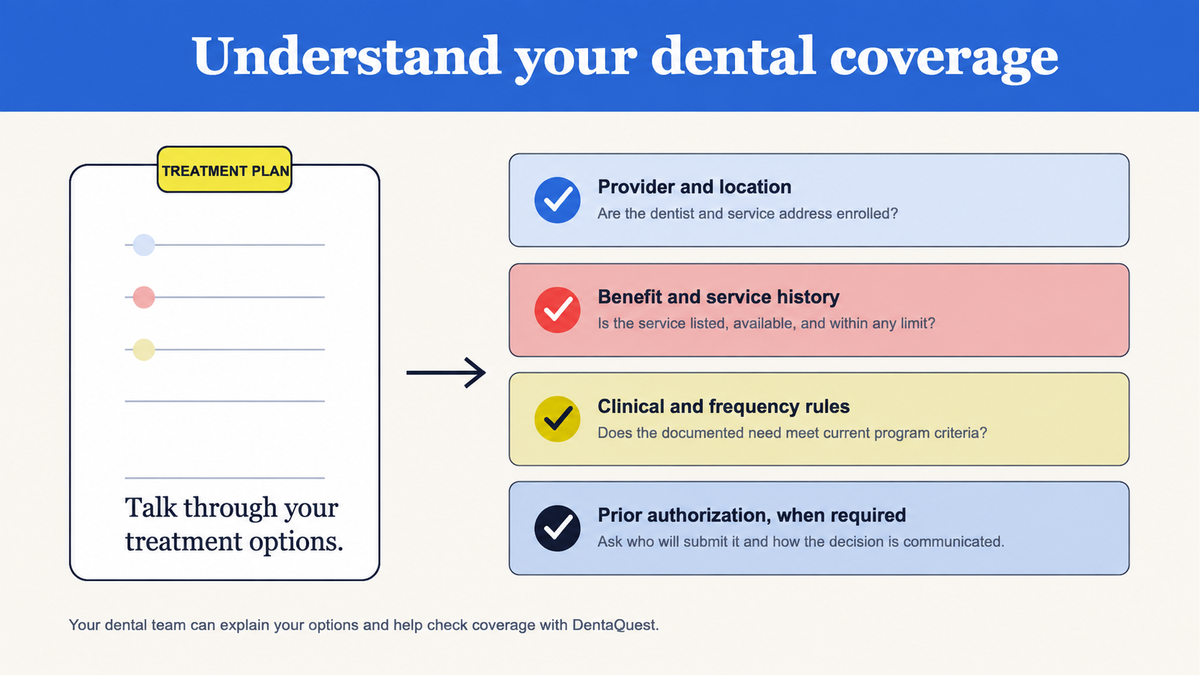
Checklist before a preventive appointment
- 1
Confirm active coverage and plan
Identify whether the member has adult Health First Colorado, standard child coverage, Cover All Coloradans, CHP+, or another program.
- 2
Confirm the office and dentist
Ask whether the exact location is enrolled and accepting the member's age group.
- 3
Share prior records
Tell the office where and when the last exam, cleaning, fluoride, sealant, or X-rays occurred. Ask the former office to transfer usable images when appropriate.
- 4
Ask what is planned today
A preventive appointment may change after the examination if the dentist finds pain, decay, gum disease, or another concern.
- 5
Verify unexpected services
Before a non-emergency addition, ask why it is recommended and whether the office has checked the exact benefit and frequency.
Planning a preventive visit with Star Dental
Star Dental offers many general dental services, including dental examinations and cleanings. The exact service, patient age, clinical need, appointment availability, and current program participation must be confirmed before care. Services that are not offered at Star Dental, or care that requires a specialist, may be referred to another participating office.
Primary sources
Verify the details that affect your care
We use official program materials and clearly identify Star Dental pages. Policies and personal benefit status can change.
- DentaQuest adult benefit summary — current
- DentaQuest children's dental benefit summary
- HCPF children's dental benefits
- DentaQuest Health First Colorado member hub
- Cover All Coloradans 2026 dental-limit notice