
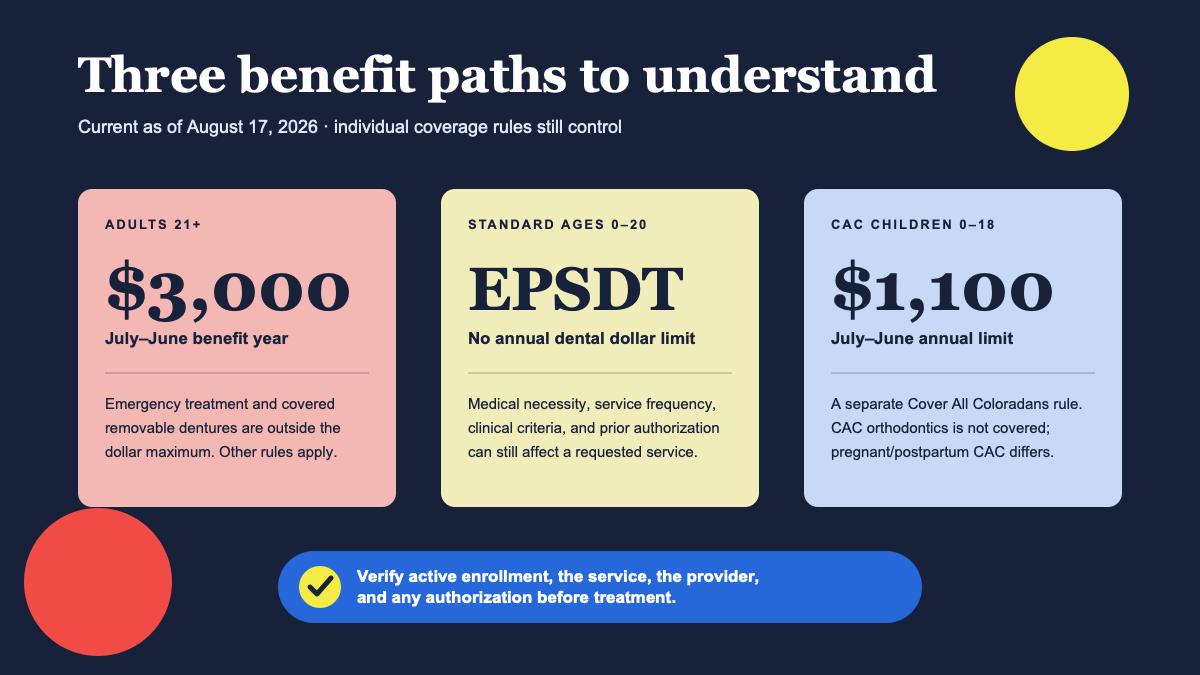
Health First Colorado members age 0 through 20 have comprehensive dental benefits, including federal Medicaid protections for medically necessary care called EPSDT.
The current Health First Colorado children's summary covers members through age 20. Separate 2026 limits apply to children enrolled through Cover All Coloradans.
EPSDT is the foundation of children's coverage
Early and Periodic Screening, Diagnostic and Treatment, usually called EPSDT, requires Medicaid to provide Medicaid-coverable, medically necessary care for members under 21. In dentistry, that can include care beyond a standard frequency when a provider documents why it is medically necessary.
EPSDT does not mean every requested procedure is automatically approved. The treating dentist may need to submit records, X-rays, measurements, or a prior-authorization request so the program can apply its clinical criteria.
Preventive, restorative, and complex care
- Exams, cleanings, covered X-rays, fluoride, and age-qualified sealants
- Fillings, protective restorations, and certain crowns
- Pulp treatment and root canals when medically necessary
- Periodontal services for members who meet age and clinical criteria
- Complete or partial removable dentures in qualifying cases
- Simple and surgical extractions
- Orthodontic treatment only when medically necessary and approved through prior authorization
Costs and limits depend on the enrollment program
The standard Health First Colorado children's summary says members age 0–20 have no dental copay, deductible, or annual dental benefit limit. Individual service frequencies, clinical rules, and authorization requirements still apply.
A child enrolled through Cover All Coloradans is subject to a separate rule beginning July 1, 2026: children age 0–18 in that program have a $1,100 July–June annual dental benefit limit, and orthodontics is not covered. CHP+ also has separate rules.
Finding Medicaid dental care for a child in Denver metro
A family or general dentist may see children, while a pediatric dentist has specialty training focused on infants, children, and adolescents. The right starting point depends on the child's age, health and access needs, the recommended service, office policies, and current network availability.
Use the DentaQuest directory and Dental Home information, then call the exact office. Ask which ages are seen, whether new Health First Colorado patients are being scheduled, what accommodations can be arranged, and whether the office can provide the service or will coordinate a specialist.
- For a first visit, ask whether the office sees infants and young children and how a caregiver should prepare.
- For a child with pain, swelling, injury, or a broken tooth, describe the symptoms and timing rather than waiting for a routine opening.
- For braces, sedation, hospital-based care, or complex treatment, verify the specialist, program rules, and prior-authorization process separately.
- If a listed office is not taking patients, document the call and ask DentaQuest for help locating another enrolled option.
Prepare for a child's dental visit
- Confirm active enrollment and the assigned or selected Dental Home.
- Tell the office about pain, swelling, injuries, medicines, allergies, and relevant health conditions.
- Bring prior dental records or authorize their transfer when possible.
- Ask what preventive schedule the dentist recommends and which services require approval.
- If a child has facial swelling, fever with dental symptoms, uncontrolled bleeding, or trouble breathing or swallowing, seek urgent professional help.
Primary sources
Verify the details that affect your care
We use official program materials and clearly identify Star Dental pages. Policies and personal benefit status can change.
- DentaQuest children's dental benefit summary
- DentaQuest children's benefit summary
- DentaQuest Health First Colorado member page