Possible life-threatening emergency
Call 911Trouble breathing or swallowing, rapidly spreading face or neck swelling, major facial trauma, confusion, or uncontrolled bleeding.
Emergency benefit guide
Use this Denver page for emergency-benefit rules and finding prompt local evaluation. Use the symptom action guide when the immediate question is whom to call and what details to report.
Choose the safest next step
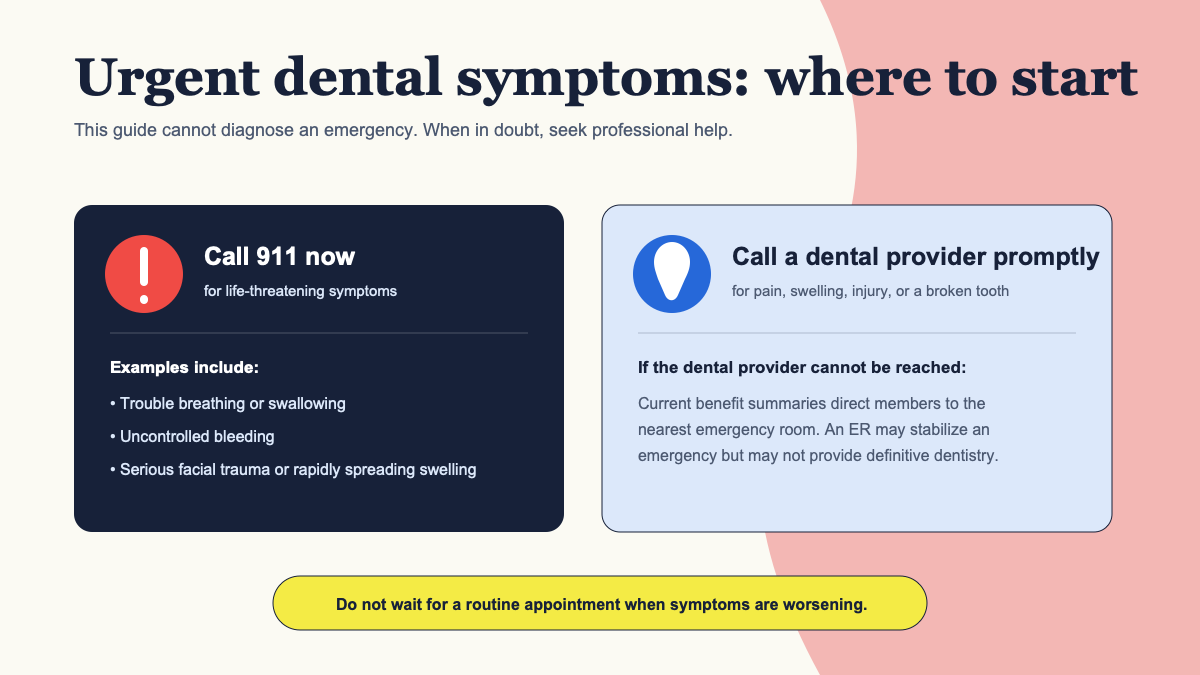
Trouble breathing or swallowing, rapidly spreading face or neck swelling, major facial trauma, confusion, or uncontrolled bleeding.
Severe or worsening tooth pain, swelling, drainage, a broken tooth, injury, or bleeding after dental treatment.
A website cannot diagnose an emergency. For a dental emergency, if you cannot reach a dental provider, current Health First Colorado dental summaries direct members to the nearest emergency room.

This illustration cannot diagnose an emergency. Call 911 for life-threatening symptoms and seek prompt professional guidance for urgent dental problems.
Open full-size visual ↗Current adult and children's summaries state that prior authorization is not required in emergency situations; the clinical facts and billing must still meet emergency rules.
This page explains Health First Colorado's emergency dental benefit and a Denver provider-search workflow. The companion symptom action guide is a safety-first checklist for choosing 911, an emergency department, the Nurse Advice Line, or prompt dental contact. Neither page can diagnose a condition or decide how a claim will be classified.
DentaQuest's adult and children's summaries state that emergency dental care has no frequency limit and does not require prior authorization. DentaQuest's 2026 benefit-limit change notice separately states that qualifying adult emergency treatment is outside the $3,000 July–June annual limit that began July 1, 2026.
The plan decides whether services qualify as emergency treatment based on the clinical record and billing. A same-day appointment or severe pain does not automatically make every proposed procedure an emergency benefit.
Tell the office when the problem began and mention swelling, fever, injury, drainage, bleeding, or difficulty opening the mouth.
Ask whether the exact location and treating dentist are enrolled and accepting urgent patients.
An urgent exam and imaging may lead to stabilization, a later treatment visit, or a specialist referral.
If you cannot find an appointment, use the official dentist finder or call the number on your member materials for help.
Star Dental offers Saturday and Sunday appointments in Denver and accepts Health First Colorado for adults and children. Call 303-222-1414 to reserve an available appointment before coming in. An office being open does not mean there is an unbooked appointment or time for every procedure that day.
When you call, say that you have Health First Colorado, give the patient's age, and explain the problem and when it started. Ask what the first visit can include, what member information to bring, and whether any next stage of care would need another appointment. These details help the team plan the visit without guessing what treatment you need.
A Saturday or Sunday appointment does not by itself confirm coverage or make a service an emergency benefit. Ask the office to check your current eligibility and the proposed treatment. If you are given a cost estimate, ask what it includes and what still needs to be confirmed with the plan.
A hospital can evaluate serious infection, trauma, bleeding, dehydration, or airway risk and may provide stabilization. Many emergency departments do not provide definitive dental procedures such as fillings, root canals, or routine extractions.
Follow the discharge instructions and arrange dental follow-up. Bring the discharge paperwork, images if available, medication list, and member information to the dentist. Do not stop or change prescribed medicine without speaking with the prescribing clinician.
Primary sources
We use official program materials and clearly identify Star Dental pages. Policies and personal benefit status can change.
Your next step
Choose the resource you need to answer your question and prepare for your next step.