
A covered category can still have eligibility, network, age, frequency, clinical, documentation, authorization, and benefit-limit conditions.
Benefit and coverage terms
The interactive glossary below includes common words from Health First Colorado dental materials. A benefit is a service category the program can pay for under its rules. Coverage is the application of those rules to a member, service, provider, and date. Medical necessity means the care meets program clinical standards; it is not established only by preference or by the presence of a diagnosis.
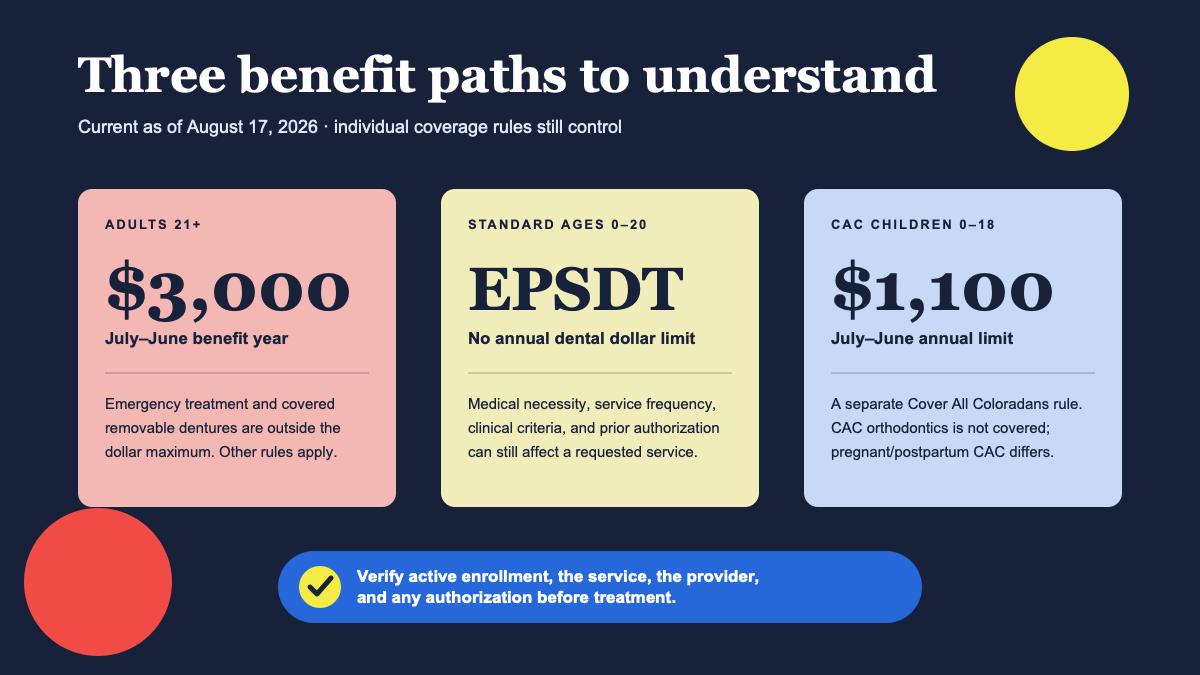
A benefit maximum is the most the program pays for services subject to that maximum during a defined period. As of July 1, 2026, standard adult dental coverage uses a $3,000 July–June annual maximum, with qualifying emergency treatment and covered removable dentures outside that dollar limit. Those exceptions still have other requirements.
Authorization, claim, and decision terms
- Prior authorization: plan review required before certain care; approval can have code, date, provider, unit, and clinical conditions.
- Claim: the request a provider sends for payment after a service, using procedure codes and other required information.
- Allowed amount: the amount recognized under the program's payment rules, which can differ from an office's standard fee.
- Adverse benefit determination: a denial, reduction, suspension, or termination of a requested or authorized benefit described in a formal notice.
- Appeal: a request to review or overturn an adverse benefit or eligibility decision under the process in the notice.
- Grievance: an expression of dissatisfaction about an issue other than an adverse benefit determination, such as communication or service quality.
Dentist, network, and Dental Home terms
A participating or in-network provider is enrolled for the relevant program, location, provider identity, and service circumstances. A directory result helps you find possible offices. Call the location you would like to visit to discuss new-patient appointments, the treating dentist, and the procedure you need.
DentaQuest uses the term Dental Home for the dental provider associated with a member in its system. Members can review Dental Home information and provider-search tools through DentaQuest. A referral is a clinical direction from one provider to another; it is different from plan authorization.
Age and program terms that change the answer
- Adult: for the standard dental summary, a Health First Colorado member age 21 or older.
- Child or youth: standard Health First Colorado members ages 0–20 use pediatric dental and EPSDT protections, without the standard annual dollar maximum.
- EPSDT: Early and Periodic Screening, Diagnostic and Treatment, the federal Medicaid child benefit that can support medically necessary care beyond listed frequency limits through the proper request process.
- Cover All Coloradans: a distinct Colorado coverage pathway. Starting July 1, 2026, enrolled CAC children ages 0–18 have a $1,100 dental annual limit; CAC orthodontics is not covered, while enrolled pregnant and postpartum CAC members do not have that $1,100 cap.
- CHP+: Child Health Plan Plus, a separate public coverage program with its own dental rules; do not apply standard Health First Colorado rules automatically.
- Dual eligible: a person who has Medicare and some category of Medicaid; the exact Medicaid category and Medicare or Medicare Advantage dental benefits affect coordination.
Cost, disclosure, and member-rights terms
No copay means the program does not require a member copayment for a covered Health First Colorado dental service. It does not mean every proposed service is covered or that a member can never choose to purchase non-covered care. A non-covered-service disclosure is the written form a participating dental provider and member complete before the member agrees to pay for truly non-covered care.
Balance billing generally means charging a member the difference between a provider's fee and what a plan pays. Colorado policy prohibits billing a Medicaid member for covered services. Coordination of benefits determines the order in which plans process a claim; Medicaid is generally payer of last resort when other coverage exists.
Primary sources
Verify the details that affect your care
We use official program materials and clearly identify Star Dental pages. Policies and personal benefit status can change.
- Health First Colorado benefits and services
- DentaQuest Health First Colorado plan
- Adult benefit summary — current
- Current child benefit summary
- Health First Colorado billing policy
- DentaQuest appeals and grievances
- Star Dental Medicaid services