
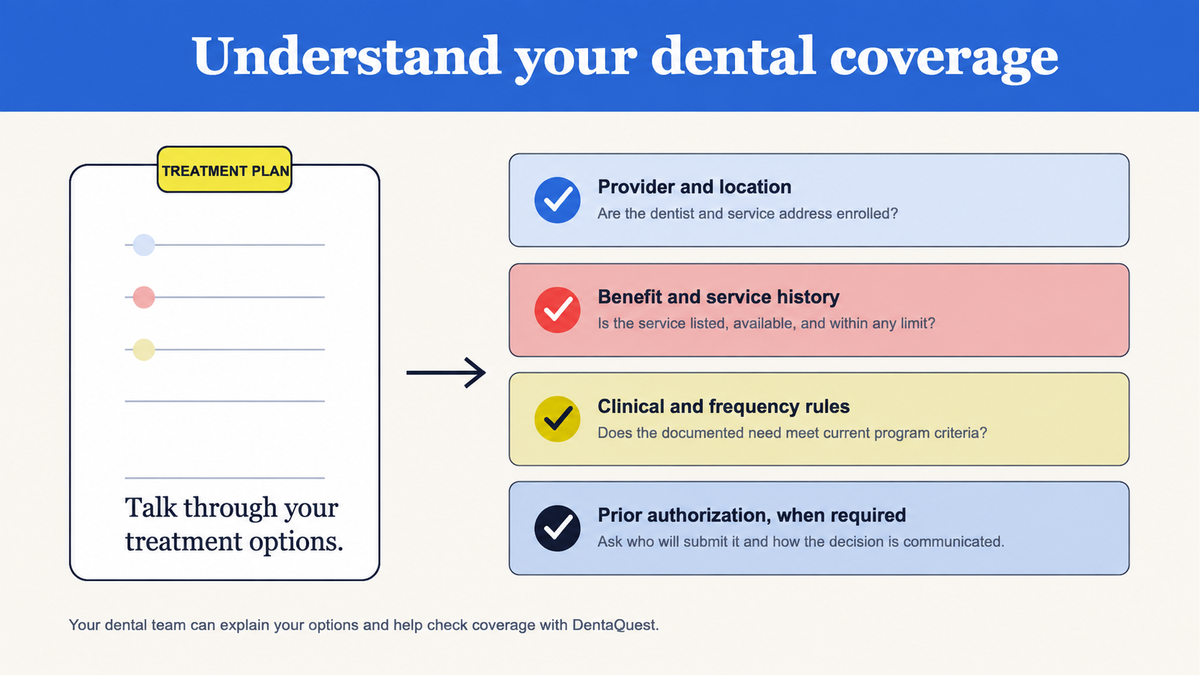
The office should check the exact service, tooth or mouth area, prior treatment dates, member program, and any required review—not only whether the treatment category appears covered.
How to use these frequency examples
A coverage timing limit describes how soon Medicaid may cover the same treatment again. It can apply to one tooth, one part of a tooth, a section of your mouth, a dental appliance such as a denture, or the whole mouth. Your dentist recommends when you need care, and the office checks the coverage rules for that treatment.
These examples focus on standard Health First Colorado. Age, diagnosis, clinical need, prior claims, benefit limits, provider participation, documentation, and authorization can change the result. Ask the dental office and DentaQuest to check the exact treatment plan and service history for the planned date of care.
Common standard Health First Colorado treatment intervals
The following are useful planning examples, not a complete benefit schedule:
- Routine cleanings: generally two within a 12-month period. Some members with documented higher decay or periodontal risk may qualify for additional combined cleaning or periodontal-maintenance visits after the dentist documents the risk and the applicable program rules are met.
- Fillings: many standard Health First Colorado filling benefits generally use a 36-month interval for the same tooth and surface. A filling elsewhere in the mouth is a separate history question, and an early failure still needs individual review.
- Permanent crowns: generally once every 84 months—seven years—per qualifying tooth. Tooth type, remaining structure, previous treatment, and whether a filling could reasonably restore the tooth still matter.
- Root-canal treatment: generally once per lifetime for a qualifying tooth. Retreatment is a different service with a different review pathway, and coverage for a root canal does not automatically confirm a buildup or crown afterward.
- Deep cleaning below the gumline (scaling and root planing): generally covered once every three years for each of the mouth's four sections—upper right, upper left, lower right, and lower left. Each section is called a quadrant. Approval before planned treatment, called prior authorization, is normally required. Regular cleanings, removal of heavy buildup before an exam, and follow-up cleanings after gum treatment have different rules.
- Removable dentures: standard replacement timing is generally seven years for adults and five years for children. Repairs, relines, rebases, and medically necessary exceptions follow separate timing and review rules.
Children's fluoride, sealants, and preventive timing
Standard Health First Colorado covers preventive dental care for members ages 0 through 20, but fluoride, sealants, space maintainers, exams, cleanings, and different kinds of X-rays do not all share one schedule. Fluoride frequency can vary by the child's age and documented cavity risk, while sealants and space maintainers have age, tooth, and treatment-history qualifications.
A child with documented higher risk may qualify for more preventive care than the ordinary schedule. The dentist should complete the risk assessment and check the current child benefit rather than having a family choose a treatment from a frequency list. Medically necessary requests for a member under 21 can also receive individualized EPSDT review.
- Tell the office when and where the child's last exam, cleaning, fluoride treatment, sealant, and X-rays occurred.
- Ask whether the child's risk assessment changes the number of preventive visits or fluoride treatments available.
- Ask which teeth a sealant or space maintainer would involve and whether the child's age and treatment history fit the current rule.
- Do not assume that a preventive service listed for standard Health First Colorado uses the same frequency under CHP+ or Cover All Coloradans.
Before-treatment approval and after-treatment review are different
Some non-emergency services require prior authorization: the dental office submits the proposed treatment and supporting records, and the plan reviews them before treatment begins. Deep cleaning below the gumline (scaling and root planing) and many removable-denture services are common examples that may need approval before treatment.
Other services may be performed first and reviewed with the claim afterward. That later review can examine the same kinds of clinical and frequency requirements, but it is not advance approval. For example, the exact crown or extraction service may follow a claim-review pathway rather than ordinary prior authorization.
- 1
Ask which review applies
The office checks the recommended treatment, the tooth or area being treated, any dental appliance involved, and your Medicaid program. Crowns, root canals, tooth removal, and sedation can have different approval steps.
- 2
Wait when advance approval is required
For non-emergency treatment, ask whether the request is approved, partially approved, still pending, or needs more records before care starts.
- 3
Check what the decision covers
Confirm the approved service, tooth or area, provider, location, quantity, and valid dates. Related parts of a treatment plan can require separate checks.
Multi-visit treatment needs more than one date check
Dentures, crowns, root canals, periodontal care, sedation cases, and orthodontics can span multiple appointments. Active coverage at the examination or first appointment does not by itself confirm every later stage. Ask the office to recheck eligibility, service history, authorization dates, and provider participation as the treatment progresses.
- 1
Dentures
The sequence may include evaluation, authorization, extractions or healing, impressions, try-in, delivery, and adjustments. Eligibility and approval should still be active when the appliance is delivered. Early adjustments may be included with the new denture, while later repairs or relines can use separate benefits.
- 2
Crowns
Preparation and final placement may occur on different dates. Ask which date completes the covered service and whether the final crown, buildup, or other related work has a separate frequency or review requirement.
- 3
Root canals
Treatment can involve evaluation, temporary care, canal treatment, and a later restoration. Ask when the root-canal service is considered complete and verify any buildup or crown separately.
- 4
Deep cleaning
Deep cleaning is planned in four sections of the mouth: upper right, upper left, lower right, and lower left. You may need more than one visit. The office can explain which sections are approved for treatment, the approved dates, and when to return for follow-up cleanings.
Do not transfer one program's schedule to another
Standard adult Health First Colorado generally applies to members age 21 and over, while the standard child benefit applies to ages 0 through 20 and includes EPSDT protections. Cover All Coloradans, CHP+, and certain HCBS waiver dental benefits have different annual periods, limits, services, and review rules.
CHP+ is a separate program and uses a January-through-December benefit year. Its current materials should be checked for the member's exact preventive and treatment history. Because frequency can depend on the service and prior claims, this guide does not assign one numeric CHP+ cleaning, fluoride, sealant, or filling schedule.
Questions to ask before scheduling treatment
- What treatment do I need, and can you show me which teeth, areas of my mouth, or dental appliance it is for?
- What does the plan's record show for the last time this service was used?
- Does the ordinary interval apply, or is the dentist requesting an individualized medical-necessity review?
- Does this treatment need approval before care, or will records be reviewed with the claim afterward?
- For multi-visit care, which date completes or delivers the covered service?
- Does each related service—such as a buildup, crown, anesthesia, facility, repair, or reline—need a separate check?
- Can this office provide every stage, or will part of the care be referred to another dentist or specialist?
Primary sources
Verify the details that affect your care
We use official program materials and clearly identify Star Dental pages. Policies and personal benefit status can change.
- DentaQuest Health First Colorado member page
- DentaQuest adult dental benefit summary — current
- DentaQuest children's dental benefit summary
- HCPF children's dental benefits
- DentaQuest CHP+ member page