Possible life-threatening emergency
Call 911Trouble breathing or swallowing, rapidly spreading face or neck swelling, major facial trauma, confusion, or uncontrolled bleeding.
Urgent dental action guide
Use this safety-first page to choose the next contact and prepare a symptom report. Use the Denver emergency guide for benefit rules and a local provider-search workflow.
Choose the safest next step
Trouble breathing or swallowing, rapidly spreading face or neck swelling, major facial trauma, confusion, or uncontrolled bleeding.
Severe or worsening tooth pain, swelling, drainage, a broken tooth, injury, or bleeding after dental treatment.
A website cannot diagnose an emergency. For a dental emergency, if you cannot reach a dental provider, current Health First Colorado dental summaries direct members to the nearest emergency room.

Call 911 for life-threatening symptoms; otherwise contact a dental provider promptly for severe or worsening dental problems.
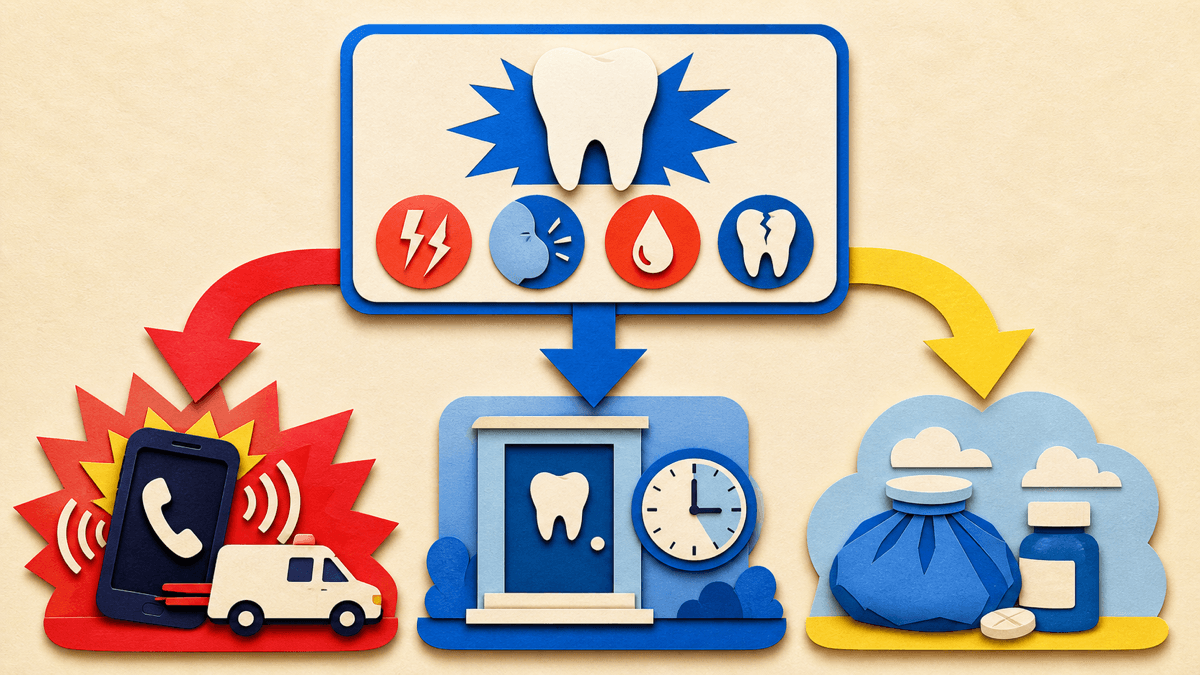
Open full-size visual ↗Trouble breathing or swallowing, serious facial trauma, uncontrolled bleeding, loss of consciousness, or rapidly spreading swelling require emergency help.
Call 911 for trouble breathing or swallowing, major injury to the face or jaw, bleeding that will not stop, loss of consciousness, or swelling that is spreading quickly toward the eye, neck, or airway. Do not drive yourself if it is unsafe. Tell the dispatcher about breathing, swallowing, bleeding, trauma, fever, medicines, allergies, and any serious medical conditions.
A hospital emergency department can evaluate and stabilize dangerous infection, bleeding, trauma, or other medical complications. It may not provide definitive restorative dentistry. After stabilization, ask what dental follow-up is needed and how quickly it should occur.
Call a dental provider promptly for significant tooth pain, a broken or knocked-out tooth, swelling, pus or a bad taste with pain, a lost restoration with symptoms, denture injury, or bleeding after a dental procedure. Describe the symptom, when it began, what makes it better or worse, recent treatment or injury, and whether there is fever or facial swelling.
The dental team decides how soon an evaluation is needed. Do not place aspirin on a tooth or gum, use someone else's prescription, or rely on antibiotics without a clinician's evaluation. If the office cannot be reached, current DentaQuest adult and child summaries tell members to go to the nearest emergency room.
DentaQuest's adult and child summaries state that emergency dental treatment does not require prior authorization. DentaQuest's 2026 adult benefit-limit change notice separately states that qualifying emergency treatment is excluded from the $3,000 annual adult benefit maximum. Those rules do not mean every painful visit or same-day procedure will be coded and covered as an emergency.
The clinical record, procedure, provider participation, active eligibility, and plan criteria control the benefit decision. Ask the office what it expects to bill and check the claim afterward. If a recommended follow-up service is not itself emergency treatment, the ordinary adult limit, authorization, frequency, and clinical rules may apply.
Primary sources
We use official program materials and clearly identify Star Dental pages. Policies and personal benefit status can change.
Your next step
Choose the resource you need to answer your question and prepare for your next step.