
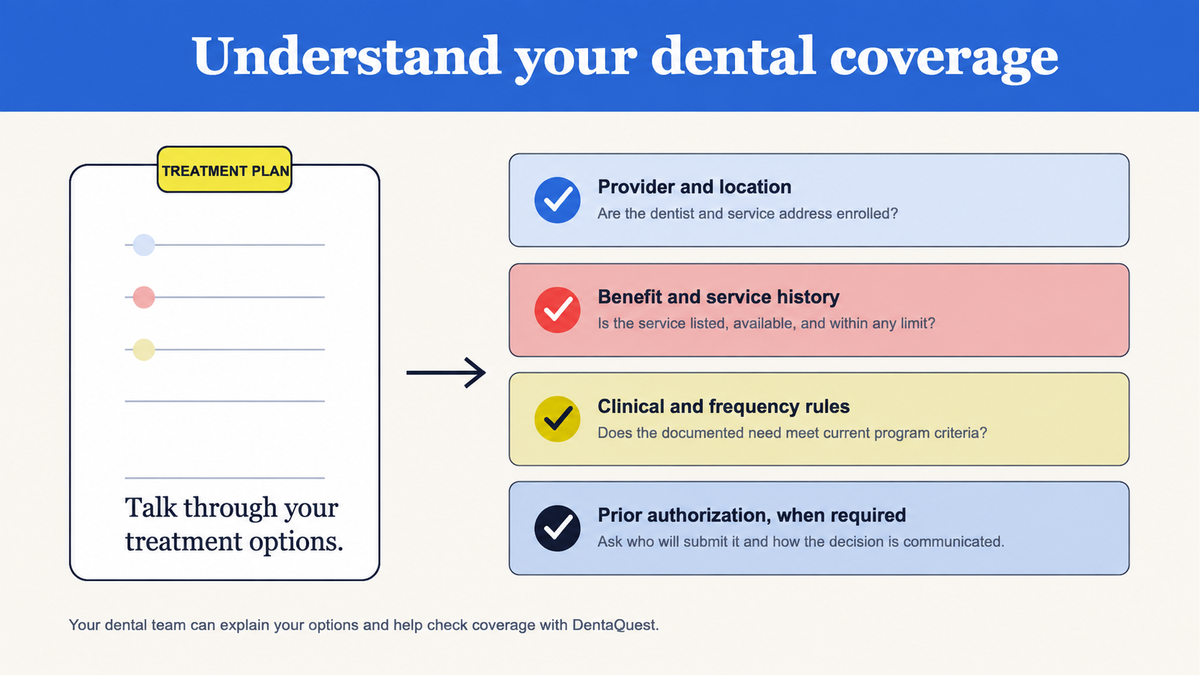
Health First Colorado can cover deep cleaning to treat gum disease. Start with a dental exam: the dentist checks your gums, explains the treatment you need, and helps you understand the next steps for coverage.
For adults with standard Health First Colorado, this limit applies separately to each of the four sections of the mouth. Deep cleaning generally needs DentaQuest’s approval before planned, non-emergency treatment. Follow-up cleanings have different timing rules.
How is a deep cleaning different from a regular cleaning?
A regular cleaning helps keep teeth and gums healthy when active gum-disease treatment is not needed. A deep cleaning treats gum disease below the gumline. Its dental name is scaling and root planing: removing plaque and hardened buildup from teeth and cleaning their root surfaces.
Sometimes heavy buildup must be removed before the dentist can fully examine the mouth. This is called full-mouth debridement and is different from deep cleaning. After gum-disease treatment, your dentist may recommend follow-up cleanings called periodontal maintenance.
If your gums bleed or you have bad breath, an exam helps the dentist find the cause and recommend the right care. A regular cleaning is not usually covered as a separate service on the same day as a deep cleaning or another gum-treatment procedure.
How often can Medicaid cover gum treatment?
These are coverage limits, not a recommendation to wait three years between dental visits. Your dentist recommends follow-up care based on your gum health. The office also checks your past treatment, any required approval, and your remaining benefit. Covered adult gum treatment generally counts toward the $3,000 July–June annual limit that began July 1, 2026.
- A detailed gum-health exam: once every three years.
- Removing heavy buildup so the dentist can examine the mouth (full-mouth debridement): generally once every three years, with records reviewed when the office requests payment.
- Regular cleanings, cleanings for widespread gum inflammation, and follow-up cleanings after gum treatment usually share a combined limit of two visits in 12 months.
- If your dentist documents a higher risk of dental disease, you may qualify for up to four total eligible cleaning or follow-up cleaning visits in 12 months after review. That is four visits combined, not four of each type.
- Deep cleaning: generally once every three years for each section of the mouth that needs treatment, with approval before planned care. Dentists divide the mouth into four sections—upper right, upper left, lower right, and lower left. Each section is called a quadrant.
- Outside a hospital, coverage normally allows deep cleaning of up to two of those four sections on one treatment date. Treating all four sections may take more than one appointment.
- Gum surgery: covered when the treatment meets the program's requirements for gum disease.
Does deep cleaning need approval before treatment?
Yes, deep cleaning under the standard adult benefit generally needs DentaQuest’s approval before planned treatment. This is called prior authorization. Your dental team sends the exam findings and treatment plan, then checks which sections of your mouth and treatment dates are approved. Separate disability-related waiver programs can have different rules.
Removing heavy buildup before an exam and follow-up cleanings after gum treatment generally follow a different process. DentaQuest reviews the records when the office sends its request for payment, called a claim. Your dental team can explain which process applies and check the other coverage requirements for your care.
What about gum treatment for children and young adults?
The standard children's benefit includes gum care for members through age 20. Some services have age or timing rules. The current summary includes removing heavy buildup before a full exam for ages 13–20, follow-up cleanings after gum treatment, deep cleaning, and gum surgery when the treatment requirements are met.
Federal Medicaid protections for members under 21, called EPSDT, require an individual review of medically necessary care that Medicaid can cover. If a child needs treatment more often than the standard schedule allows, the dentist can send records explaining the need so the program can review the request.
What to expect before a deep-cleaning decision
The first step is a gum-health exam. Your dentist checks what is happening below the gumline and recommends care based on the findings.
Your dental team gathers the needed records and explains the coverage decision. Before planned deep cleaning, they can tell you whether all or part of the treatment is approved, or whether the request is still being reviewed.
- An exam to find out whether you have gum disease
- Measurements of the spaces between your gums and teeth
- X-rays or other records needed to understand the problem
- A plan showing which teeth or sections of your mouth need treatment
- Details of past gum treatment and follow-up cleanings
- An appointment plan if more than two of the mouth's four sections need deep cleaning
- Approval before deep cleaning, when required
Questions before treatment—and symptoms that need prompt care
- 1
What is happening with my gums?
Ask the dentist to explain what the exam showed and why a regular cleaning, deep cleaning, follow-up cleaning, or other treatment is recommended.
- 2
Which areas and treatment dates are involved?
Ask which teeth or sections of your mouth need care and how many appointments are planned. Coverage timing can apply to a single tooth, a section of the mouth, or a visit.
- 3
Has coverage been verified?
The office can check that your Medicaid is active, review your past cleanings and remaining benefit, and confirm approval for the areas being treated.
- 4
What follow-up is recommended?
Ask when to return for follow-up cleanings and how to care for your teeth and gums at home. Follow the instructions your dental team gives you.
- 5
What changes need urgent help?
Contact a dental professional promptly for worsening swelling, pus or drainage, severe pain, fever with dental symptoms, or uncontrolled bleeding. Call 911 for trouble breathing or swallowing or rapidly spreading swelling.
Planning gum care with Star Dental
Start by booking an evaluation at Star Dental to discuss your gum health. The team can explain the care offered for your age and needs, check your Medicaid program, and help plan the next step. If you need a gum specialist, called a periodontist, or treatment offered elsewhere, the team can help with a referral to a participating office.
Primary sources
Verify the details that affect your care
We use official program materials and clearly identify Star Dental pages. Policies and personal benefit status can change.
- DentaQuest adult benefit summary — current
- DentaQuest children's dental benefit summary
- DentaQuest Health First Colorado member hub
- HCPF EPSDT program