
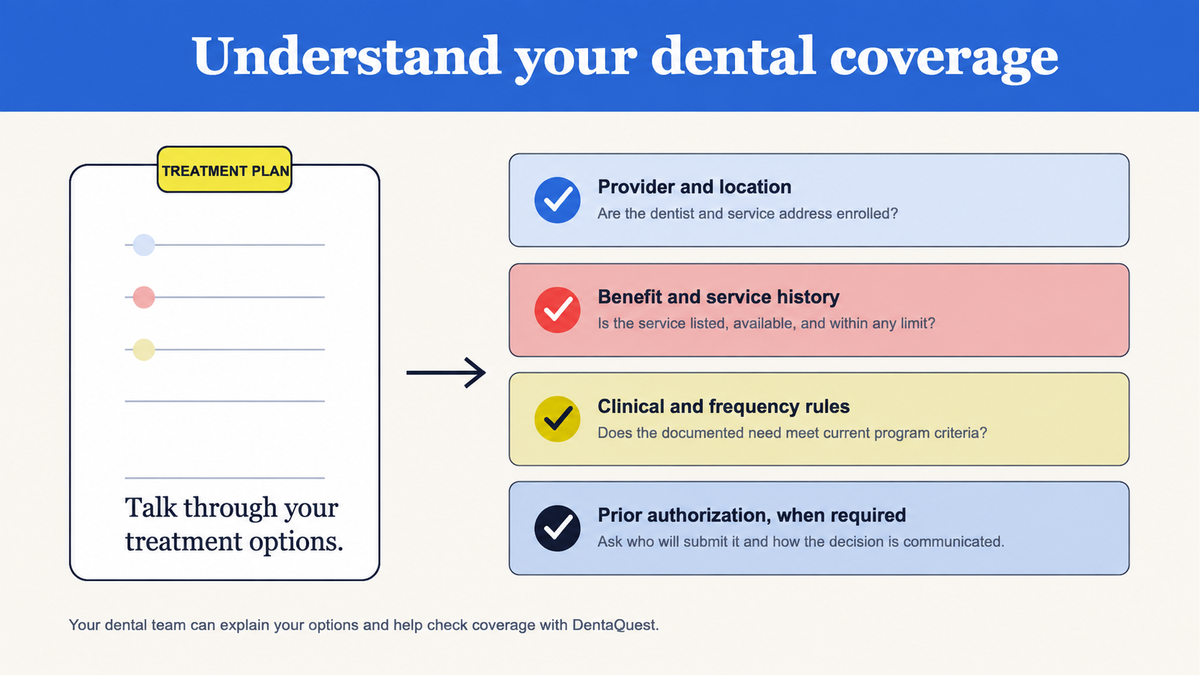
Health First Colorado lists benefits for repairing teeth and treating problems inside a tooth, including fillings, crowns, and root canals. Coverage depends on the tooth, diagnosis, prior treatment, member group, and current benefit rules.
The name of a service alone is not enough. The provider must match the proposed code to clinical criteria and the member's treatment history.
Dental fillings
Current adult and children's summaries list covered silver and tooth-colored fillings. Under the general standard Health First Colorado rule, a covered filling on the same tooth and same surface is available once every 36 months. A different surface, a new cavity, a failed filling, and a cosmetic replacement are not automatically treated the same.
A dentist must determine whether a filling is appropriate or whether the tooth needs a different restoration, root-canal treatment, extraction, or monitoring. Medicaid coverage does not substitute for that clinical decision.
Crowns
The current adult summary lists crowns once every 84 months per tooth, with added criteria for second molars and no adult benefit for crowns on third molars. Children's coverage varies by crown type, age, and tooth and remains subject to medical necessity.
Adult crown claims commonly use review after treatment and before payment rather than routine before-treatment authorization. Children's crown services can use different review routes. Ask the office which route applies, what records are needed, and how the tooth-specific criteria were checked before the tooth is prepared.
Root-canal treatment
Current summaries list root-canal treatment once per lifetime per qualifying tooth. The adult summary applies additional criteria to second molars and does not list third-molar root canals as covered. Children's rules are based on age, tooth, medical necessity, and EPSDT.
An initial root canal on a qualifying tooth generally does not use before-treatment authorization, while retreatment generally requires authorization and supporting records. The review route can vary with the tooth, age, and exact service, so the treating office should verify the current rule.
Coverage for a root canal does not automatically include a buildup or crown, and approval of a crown does not automatically include root-canal treatment. Ask the office to verify each part of the treatment sequence separately.
Plan the whole tooth, not just the root canal
Before treatment starts, ask for a written plan that follows the tooth from diagnosis through its final restoration. Root-canal treatment addresses the inside of the tooth; a crown or another final restoration may be needed afterward to protect it and restore function. Ask the dentist which restoration is appropriate and when it should be completed. The coverage review should follow that same sequence.
- 1
What does the tooth need?
Ask which examination findings and X-rays support the recommendation, whether the tooth can be restored, and whether the proposed service is initial treatment or retreatment.
- 2
What is included in each service?
Request the planned codes for the root canal, any separately indicated buildup and the final restoration. Some components may be included in another procedure rather than separately billed.
- 3
What is confirmed, and what is still pending?
For each proposed service, ask which coverage criteria apply, whether advance authorization is required, and what documentation must accompany a later claim.
Which records can help move the plan forward?
Tell the office about earlier treatment on the same tooth, even if it happened elsewhere. Ask your previous dentist to transfer relevant X-rays, treatment dates and clinical notes. A dated image after root-canal treatment can be important when coverage for the final crown is reviewed. A request to repeat root-canal treatment may need additional supporting records.
Existing records help the new dentist understand what was done. They do not automatically eliminate the need for a new examination or clinically necessary images. Ask whether the records received are usable and whether anything is missing. Bring an authorization or decision letter if you have one, but arrange secure transfer of clinical records rather than posting them publicly.
Check the benefit balance and treatment dates together
For standard Health First Colorado adult members age 21 and older, the current dental limit is $3,000 per benefit year, July 1 through June 30, effective July 1, 2026. Covered emergency treatment and covered removable dentures are excluded from that limit. This does not mean that every procedure on a painful tooth, or every follow-up restoration after an emergency visit, is automatically exempt. Ask how each planned service will be classified.
Ask how the available balance affects the complete treatment plan and whether any part remains unconfirmed. Do not postpone recommended urgent care simply to wait for July. Age, member program, eligibility, tooth-specific criteria and prior treatment can change the answer; the standard adult limit is not the rule for every member group.
Before restorative treatment begins
- Ask which teeth and surfaces are involved and request the proposed procedure codes.
- Confirm the office and treating dentist are enrolled for the date and location of service.
- Ask whether a previous filling, crown, or root canal affects the frequency rule.
- Ask whether prior authorization is required and whether the decision is final.
- Ask how the adult or Cover All Coloradans annual limit may affect the plan.
- Seek prompt care for swelling, fever with dental symptoms, facial trauma, or trouble breathing or swallowing.
Questions about an approval or an unfinished plan
- 1
My Medicaid is active. Does that mean the tooth is approved?
No. Active enrollment is one check; whether the proposed treatment meets benefit criteria is another. Ask the office to distinguish eligibility verification from a service-specific coverage review.
- 2
The office submitted the request. Can I schedule treatment?
Ask whether the service actually requires advance authorization and whether the request is pending, approved or needs more records. An approved request has an applicable scope and expiration date; it is not an unconditional payment guarantee. Other services are reviewed after treatment and before payment. The office should identify the route for your specific plan, not describe every review as prior authorization.
- 3
My root canal is finished. What should I confirm next?
Ask which final restoration is recommended, who will provide it and when to return. Confirm that the receiving office has the necessary records and has reviewed coverage for that restoration separately. Follow the treating dentist's instructions while the tooth is being restored; reduced pain alone does not tell you that every treatment step is complete.
Primary sources
Verify the details that affect your care
We use official program materials and clearly identify Star Dental pages. Policies and personal benefit status can change.
- DentaQuest adult dental benefit summary
- DentaQuest children's dental benefit summary
- Health First Colorado benefits and services
- DentaQuest Colorado coverage resources
- DentaQuest adult benefit-limit change, effective July 1, 2026
- AAE: root-canal treatment and final restoration
- AAE: care after root-canal treatment