
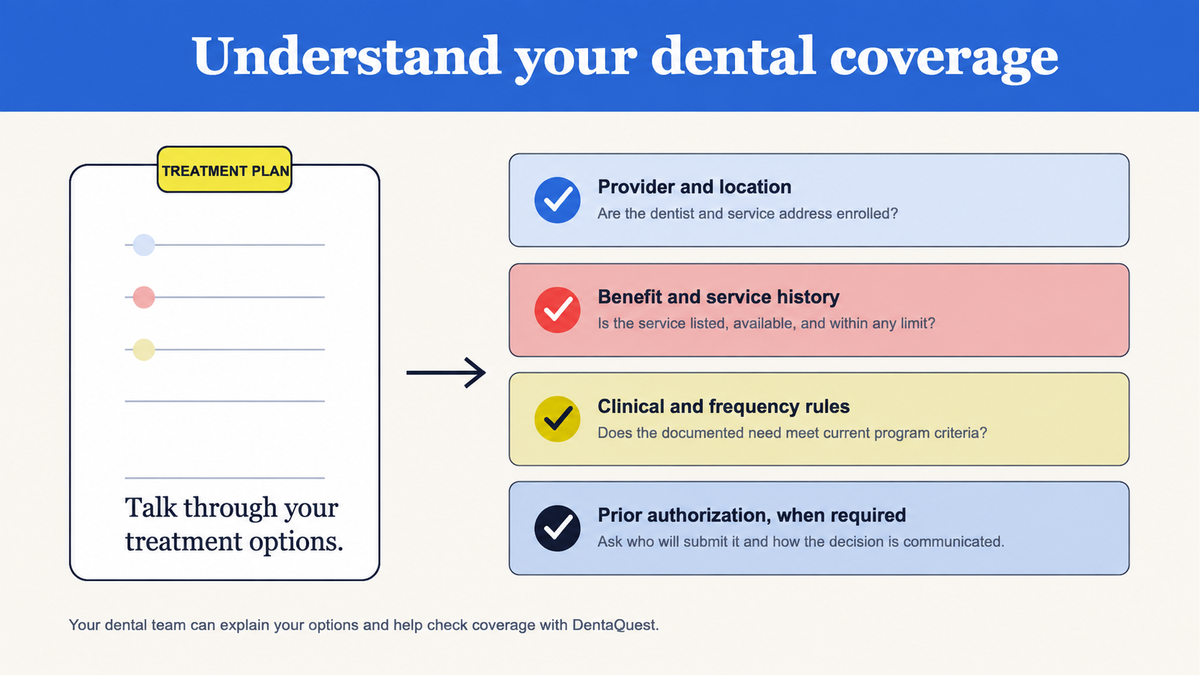
The answer depends on your program. Children covered through EPSDT and eligible DD/SLS waiver members have different benefits from standard adult coverage. Your dental team can help check which rules apply.
DentaQuest's current adult summary lists implants and fixed partial dentures ('bridges') as not covered benefits for the standard adult Health First Colorado dental plan.
The standard adult benefit has a clear exclusion
For members age 21 and older using the standard Health First Colorado adult dental benefit, DentaQuest's current adult summary identifies both implants and fixed partial dentures, commonly called bridges, as not covered. Adult orthodontia is also listed as not covered. The separate 2026 benefit-limit change did not add these excluded services.
A dentist may still discuss an implant or bridge as a clinically appropriate option. Clinical recommendation and benefit coverage are different questions. Ask for the exact procedure codes and a written explanation of covered alternatives before deciding how to proceed.
Children and waiver members require a separate review
Children age 20 and younger in standard Health First Colorado receive medically necessary dental services under EPSDT. A provider can request care beyond listed frequency summaries when medically necessary, but EPSDT does not mean every requested device or material is automatically covered. DentaQuest must review the exact service and documentation.
Eligible adults in the Developmental Disabilities or Supported Living Services waivers, and the State Supported Living Services Program, may have additional HCBS dental benefits. The dated DIDD summary lists fixed bridges and implants only to support bridges or dentures, subject to waiver limits, frequency, medical necessity, and authorization. That narrow waiver language is not a general implant benefit for all Medicaid members.
Ask about covered ways to restore function
The current standard adult summary lists removable complete and partial dentures as covered once every seven years when program criteria are met. DentaQuest's 2026 benefit-limit change notice separately states that the covered removable denture itself is not subject to the adult $3,000 annual limit, while related services such as repair, reline, or rebase have their own frequencies and may count toward the limit.
A removable option is not necessarily suitable for every mouth, and the benefit summary is not a treatment plan. An enrolled dentist must evaluate oral health, remaining teeth, healing, function, service history, and applicable clinical criteria. Ask how any extraction, temporary appliance, definitive denture, repair, or follow-up is coded and authorized.
- Talk with the dentist about the diagnosis, recommended care and how your benefits apply.
- Separate services expected to be covered from optional or excluded upgrades.
- Ask DentaQuest about benefit history, frequency, and prior authorization before irreversible care.
- Do not assume 'dentures do not count toward the cap' means every prosthetic service or upgrade is exempt.
Noncovered care needs a documented payment agreement
Colorado's billing policy says a Health First Colorado member cannot be billed for a covered service. A member may be charged for a genuinely noncovered item or service only when the provider and member enter a documented written agreement in which the member agrees to pay. The agreement should identify the specific noncovered care and cost before it is provided.
A claim denial caused by provider error, missing authorization, or late filing does not automatically convert a covered service into a billable noncovered service. If a bill is unexpected, do not ignore it: request the claim explanation, the signed agreement, and the codes, then contact DentaQuest or the Health First Colorado Member Contact Center.
Five checks before accepting a private-pay plan
- 1
Verify active eligibility and program
Identify standard adult Health First Colorado, child EPSDT, CHP+, Cover All Coloradans, or an eligible HCBS waiver benefit.
- 2
Use an enrolled provider
Confirm the dentist and exact service location in the appropriate DentaQuest network.
- 3
Obtain the complete treatment plan
Ask for codes, sequencing, alternatives, authorizations, and expected member responsibility—not only a package price.
- 4
Verify with DentaQuest
Ask what is a benefit, what criteria or frequency applies, and whether a determination must be submitted. Use the conversation to plan your next step; the plan will review the submitted service and records when deciding payment.
- 5
Review any written agreement
Sign only after the noncovered service and full price are clear. Keep a copy with the treatment plan and benefit communications.
Primary sources
Verify the details that affect your care
We use official program materials and clearly identify Star Dental pages. Policies and personal benefit status can change.
- DentaQuest: Adult Dental Benefit Summary (current)
- DentaQuest: Health First Colorado member page
- HCPF: Children's Dental Benefits
- HCPF: HCBS Dental Services
- DentaQuest: Health First DIDD Dental Benefit Summary
- HCPF: Billing Health First Colorado Members
- DentaQuest: Colorado noncovered-service disclosure form