
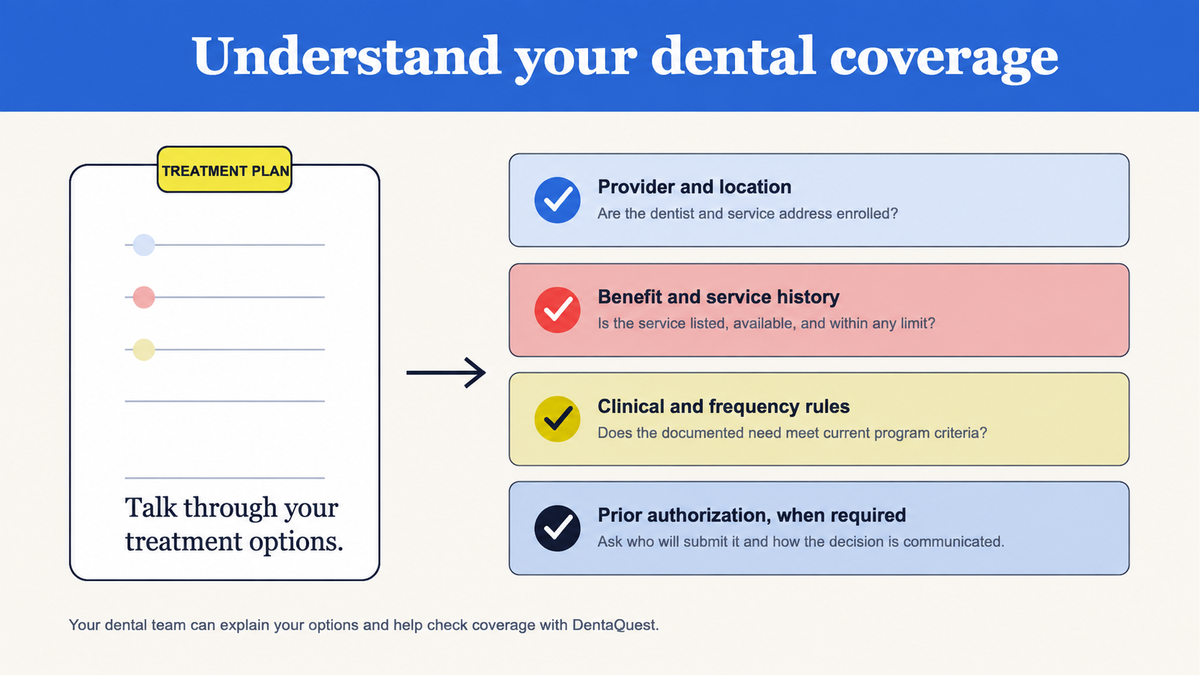
Sedation is not an automatic add-on to covered dental work. The member, procedure, sedation level, provider credentials, setting, medical necessity, and separate dental or medical authorizations can all affect coverage.
A covered dental procedure does not by itself approve anesthesia or a hospital/ambulatory-surgery setting; different professionals and benefit systems may review each part.
What the current benefit summaries say
The current Health First Colorado adult summary lists deep sedation/general anesthesia and IV conscious sedation when provided with covered services. The children's summary lists deep sedation/general anesthesia, nitrous oxide, IV conscious sedation, and non-IV conscious sedation with covered services. Both summaries list these covered sedation categories as allowed once per day.
These category listings do not mean the most intensive option is covered whenever a patient is anxious or a dentist prefers it. Anxiety alone does not automatically establish coverage for deep sedation, general anesthesia, or facility care. The treating professionals must determine whether the proposed level and setting are safe and medically necessary, and the applicable plan must review the required records.
Clinical need and safe delivery drive the review
A dental and medical history can affect whether office treatment, sedation, or facility care is appropriate. The provider may need records about diagnoses, prior treatment attempts, medications, allergies, airway or breathing concerns, pregnancy, seizure history, behavioral or communication needs, and the amount and urgency of dental work.
Coverage criteria are not instructions for a patient to select a sedation level. A qualified dentist, anesthesia professional, and—when relevant—the member's medical team should evaluate the plan. DentaQuest or the applicable medical plan then decides coverage under current program rules; approval is not a prediction that a procedure is risk-free.
- Give the provider a complete medication and allergy list.
- Report previous anesthesia, sedation, or airway problems and relevant specialist care.
- Ask who will administer and monitor the anesthesia and what credentials apply at that location.
- Follow only the individualized fasting, medication, transportation, and aftercare instructions from the clinical team.
Office and facility care follow different coverage pathways
Office-based sedation is reviewed with the covered dental treatment, the exact sedation level, the patient's clinical needs, and the qualifications and location of the treating professionals. Planned treatment in a hospital or ambulatory surgery center uses a separate facility pathway and may require coordination with the member's medical plan.
The dental procedure, the anesthesia professional's service, and the hospital or ambulatory-surgery facility are separate coverage decisions. Approval for one part does not approve the others, so do not schedule a planned facility case based only on a dental authorization number.
Build one checklist for every part of the case
- 1
Confirm eligibility and network
Verify active coverage for every planned date and enrollment of the dentist, anesthesia professional, and facility under the benefit each will bill.
- 2
List every proposed service
Ask for the dental procedures, sedation or anesthesia service, facility, diagnostic work, and follow-up in a written, sequenced plan.
- 3
Identify each decision-maker
Ask which items go to DentaQuest, the member's medical plan or utilization vendor, and the facility. One entity may not be able to verify another's claim.
- 4
Collect written determinations
Check approved services, providers, location, dates, and conditions. The office can also review current eligibility and any changes to the claim details that affect payment.
- 5
Plan the day safely
Confirm individualized fasting and medication instructions, responsible-adult and transportation rules, accessibility needs, post-procedure supervision, and whom to call with a complication.
Do not confuse emergency stabilization with planned facility dentistry
For severe facial trauma, uncontrolled bleeding, trouble breathing or swallowing, or rapidly spreading swelling, call 911 or go to the nearest emergency department. Emergency departments can evaluate and stabilize dangerous conditions, but they may not provide definitive dental repair, root canal treatment, extraction, or a complete sedation plan.
For urgent pain or swelling without those danger signs, contact an enrolled dental provider promptly and describe the symptoms. Ask what can be evaluated now, what needs authorization later, and whether the member's medical conditions or support needs require a different setting. This guide cannot determine urgency or medical suitability.
Primary sources
Verify the details that affect your care
We use official program materials and clearly identify Star Dental pages. Policies and personal benefit status can change.
- DentaQuest: Adult Dental Benefit Summary (current)
- DentaQuest: Children's Dental Benefit Summary
- DentaQuest: Health First Colorado member page
- DentaQuest: Find a Provider
- HCPF: Hospital Services
- HCPF: Member Contact Center