
DentaQuest's finder can filter for special needs, handicap accessibility, sedation, provider language, patient age, specialty, and offices reporting that they accept new patients.
Turn “accessible” into specific appointment needs
Accessibility can involve the building, dental equipment, communication, sensory environment, transfers, positioning, behavior support, clinical complexity, or transportation. Two patients who both select 'special needs' may need very different arrangements. Write down what makes care safe and usable before searching.
- Mobility: step-free route, door width, accessible restroom, lift or transfer help, wheelchair positioning, or an operatory with sufficient turning space.
- Communication: American Sign Language interpreter, captioning, plain-language explanation, communication board, large print, extra processing time, or another language.
- Sensory or behavioral support: quieter time of day, reduced waiting, caregiver presence, desensitization visits, breaks, or a predictable visit sequence.
- Medical or clinical support: medication review, oxygen or aspiration concerns, seizure plan, positioning limitations, sedation evaluation, or hospital/facility access when clinically appropriate.
Use the directory to build a call list
- 1
Choose the exact Colorado plan
Select Health First Colorado, CHP+, or the program shown in the member's DentaQuest information. Similar plan names do not share every provider or benefit rule.
- 2
Search a realistic radius
Start near home, then widen by distance if the needed specialty or accommodation is scarce. Consider transportation time and the number of visits a treatment may require.
- 3
Apply only useful filters
Try accepting new patients, special needs, handicap accessible, uses sedation, language, age, and specialty. Over-filtering can hide offices worth calling.
- 4
Save several options
Directory data and schedules can change. Build a short list and verify every item directly rather than relying on the first result.
Call the office with an access-and-coverage script
Ask to speak with someone who can confirm both the facility and clinical arrangements, not only insurance intake.
- Are the treating dentist and this exact address enrolled for the member's DentaQuest plan?
- Are you taking new patients of this age, and can you provide the needed exam or specialty service?
- The directory lists this office for [filter]. What does that mean at this location in practical terms?
- Can you meet these specific mobility, communication, sensory, behavioral, or caregiver needs?
- Will the patient remain in a wheelchair, need a transfer, or require particular positioning—and what equipment and trained assistance are available?
- Can an interpreter or auxiliary aid be arranged, who arranges it, and how much advance notice is needed?
- If sedation or facility care might be considered, who evaluates medical necessity and obtains each required authorization?
Use member supports for communication and transportation
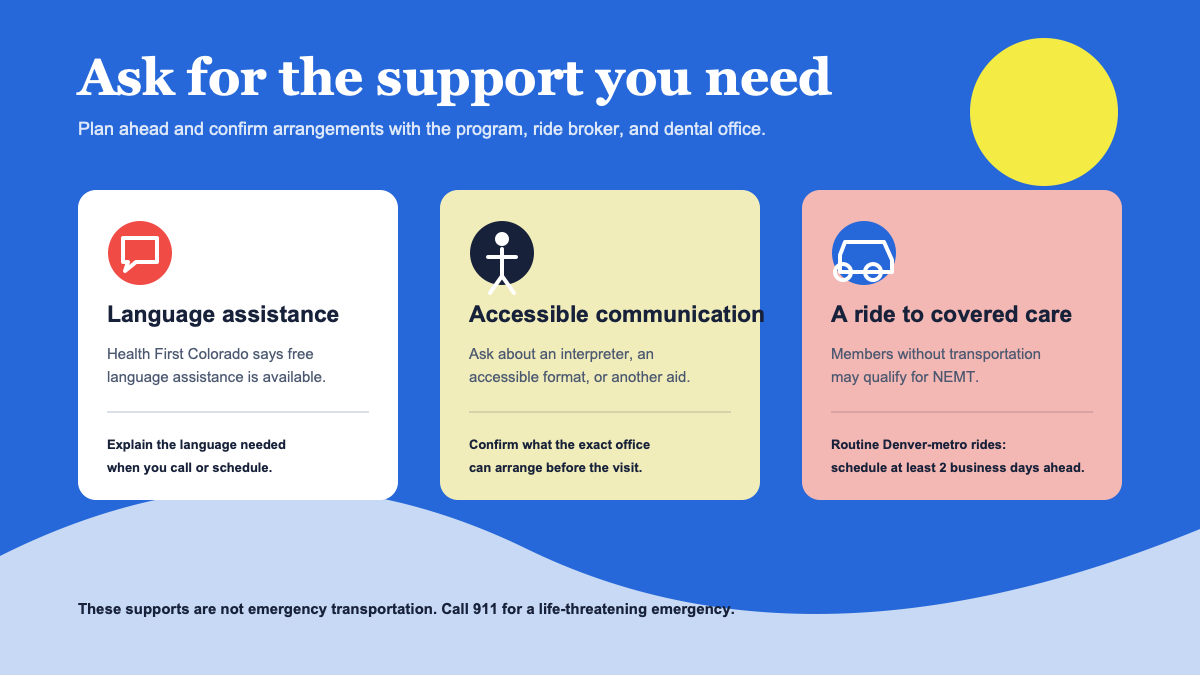
HCPF states that qualified people with disabilities can request auxiliary aids and services for effective communication with the Department, including sign-language interpreters and information in alternate formats. Health First Colorado also lists free language services. These rights do not mean every dental office has every accommodation immediately available, so request what is needed as early as possible.
Eligible Health First Colorado members who have no other means of transportation may qualify for non-emergency medical transportation to covered care. NEMT eligibility, advance-notice, mileage, escort, and transportation-provider rules apply. Confirm both the dental appointment and the approved transportation arrangements so they are ready for the visit.
Escalate when directory calls do not produce care
- 1
Document the search
Keep the date, office, phone number, person reached, plan, reason the office could not schedule, and accommodation discussed. Do not record private clinical detail you do not need.
- 2
Call DentaQuest
Use the number on the member ID or current member page. Ask for provider-search help that includes the required age, specialty, accessibility, and geographic needs.
- 3
Ask about care coordination
For complex needs, ask DentaQuest, the member's regional organization, case manager, primary medical team, or waiver case manager what coordination is available.
- 4
Use complaint or civil-rights channels when appropriate
If the issue is a benefit denial, follow the appeal notice. If it concerns discrimination or failure to provide required communication access, review HCPF's ADA process or the DentaQuest grievance information rather than treating it as a routine scheduling problem.
Primary sources
Verify the details that affect your care
We use official program materials and clearly identify Star Dental pages. Policies and personal benefit status can change.
- DentaQuest: Find a Provider
- DentaQuest: Health First Colorado member page
- HCPF: ADA and Section 504
- HCPF: Accessible Health First Colorado Member Handbook
- Health First Colorado: Non-Emergent Medical Transportation
- HCPF: Member Contact Center